The Étude Sky
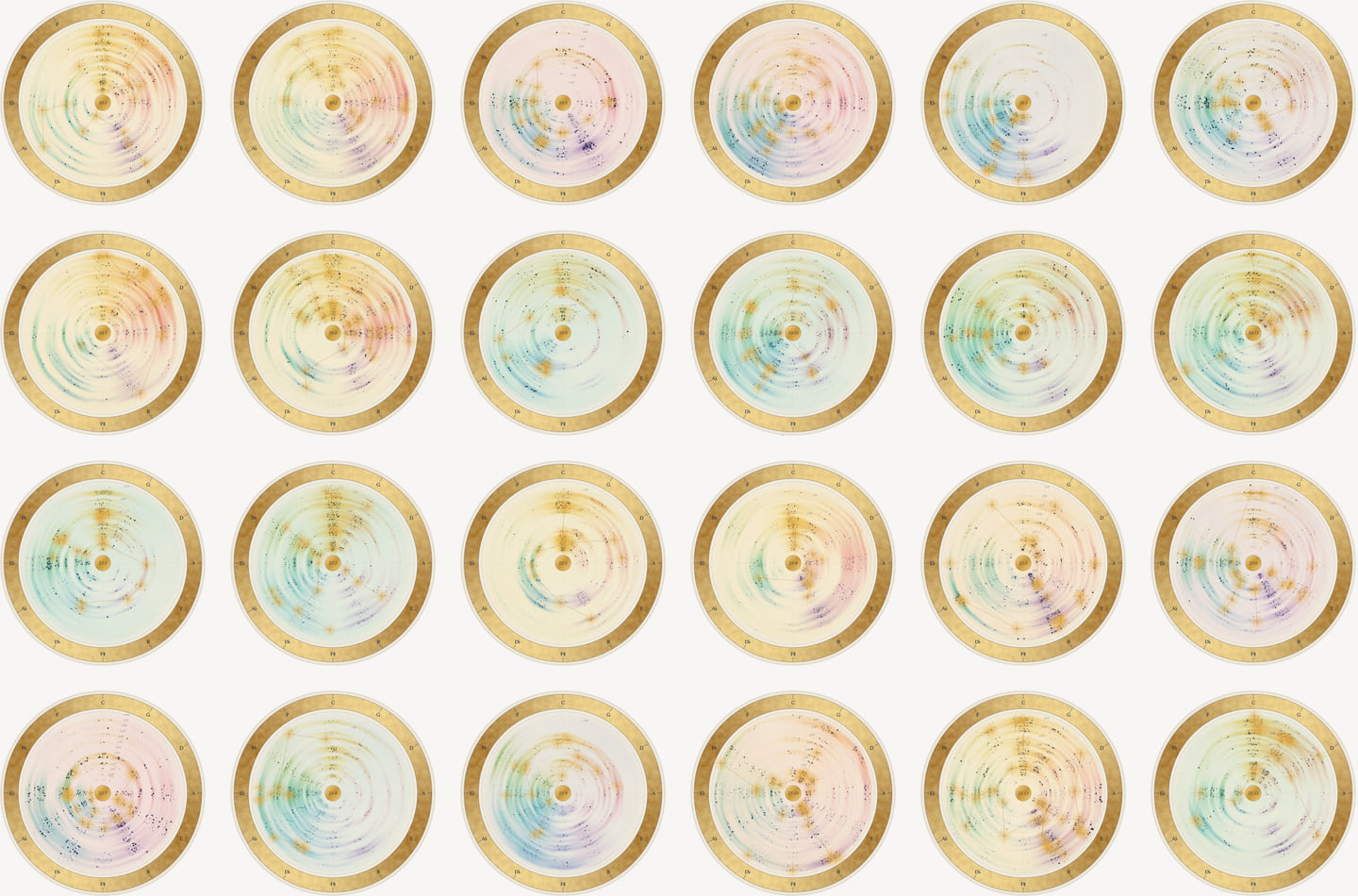 The Étude SkyChopin's twenty-four études, charted as starsView Now
"Nature always wears the colors of the spirit."
When I look up at the night sky, I think of Chopin's études. The Étude Sky is the picture that forms in my mind: each étude a star, placed by its key, and each a plate drawn from the music itself. Someone else, looking up, would see another sky.
Every mark is computed from the music. I analyze each recording once, with a chromagram for pitch class, spectral flux for note onsets, and gated loudness for magnitude, then draw the chart, the plates, and the handscroll from that analysis by fixed rules.
The Chart
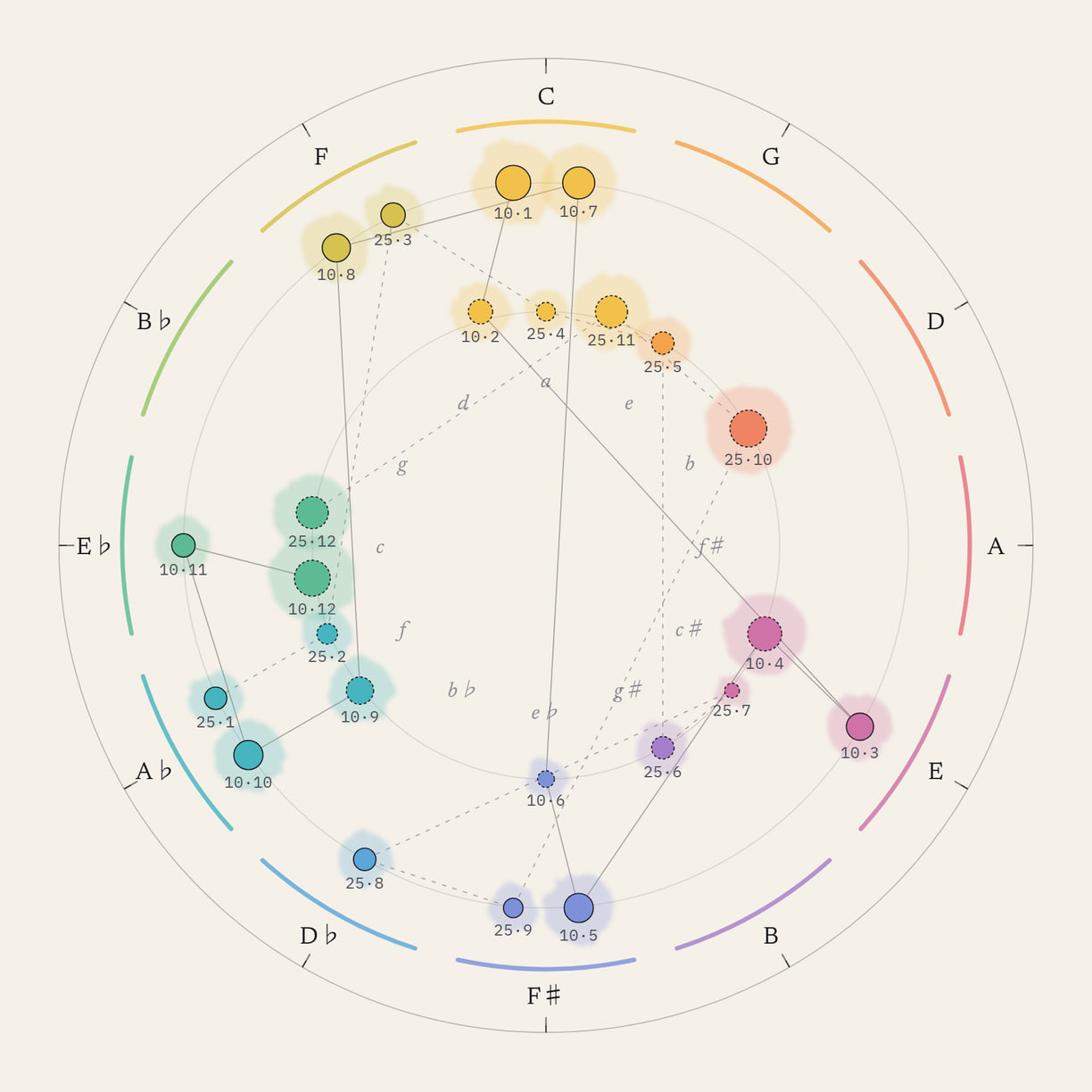
Each étude is a star. Its position angle is its key on the circle of fifths: C at 0°, each fifth 30° clockwise. Major keys sit on the outer ring and each relative minor on the inner ring, at the same angle. Fifteen keys hold all twenty-four études, so études in one key form multiple stars: a triple in A minor and seven doubles.
A star's color is its key, and its size is its apparent magnitude: the recording's loudness on Pogson's scale, one magnitude to 4 dB, with the mean of the twenty-four at magnitude 3. Op. 10 and Op. 25 are each joined in order of publication as two asterisms, solid and dashed. Op. 10 is built mostly from pairs in relative keys; Op. 25 moves more often by a third.
The Plates
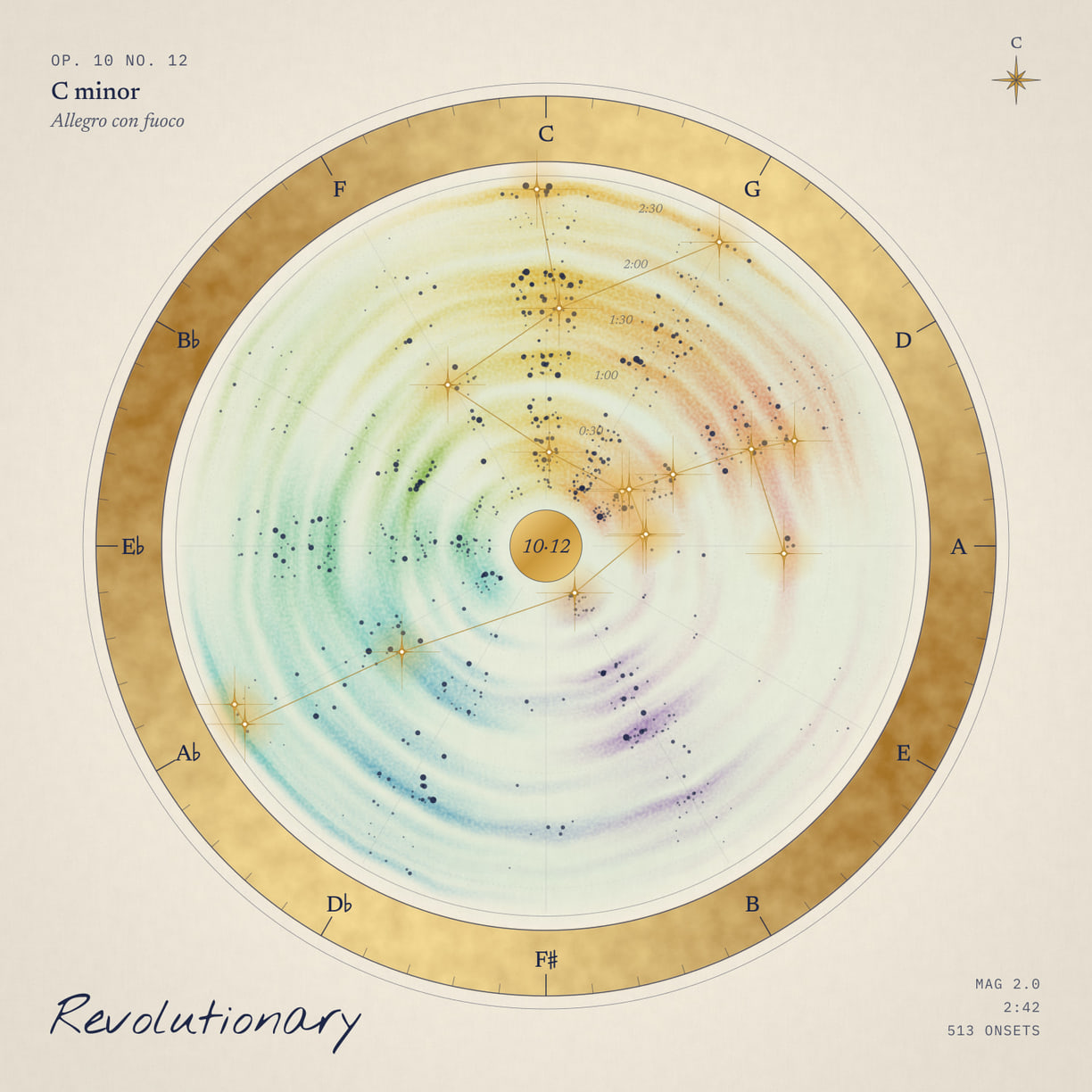
Each plate is drawn from its recording by one set of rules, inside a gilded astrolabe ring. Position angle is pitch class on the circle of fifths; distance from the center is time; every point is a note as it is struck, sized by its strength. Each pitch class keeps its color from the wheel, laid where and when it sounds, and gold joins the strongest notes in a minimum spanning tree.
The Handscroll
Beneath the chart, each étude is written out as a handscroll. Its twelve rows are the circle of fifths laid flat, and time runs from left to right, as in a piano roll. Every note is a stroke of watercolor in the color of its pitch, pressed where the key is struck and thinning as the string dies away. The scroll unrolls with the music, so each stroke appears as its note sounds; what is still to come shows faintly, like the underdrawing in a copybook.
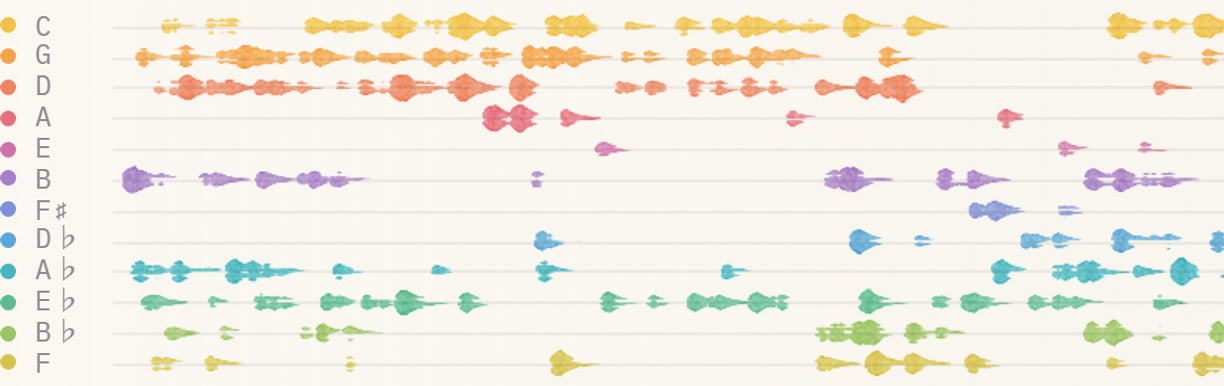
A key reads as a band of neighboring rows, and a change of key as that band moving. The paper is laid by the true solar time at which you arrive, so no two visits are painted quite alike.
The Music
The recordings are Edward Neeman's, made for Musopen's Set Chopin Free (2014) and in the public domain. I trimmed each one and matched their loudness. Two decks crossfade, so one étude hands over to the next without a gap, and the full cycle runs 62 minutes.